What we research

We are part of the Department of Computer Engineering, Automation and Robotics at the University of Granada. Our focus is active vision: sensors that change their point of view, adapt how they perceive their environment, and select the information the task needs, so that robots can make smart decisions in real time.

Active vision and robotics

Perception-action loops, attention, and collaboration for robots that look where the task requires.

Neuromorphic vision

Event-based cameras for low-latency clustering, tracking, contour detection, and navigation.

Real-time architectures

FPGA and edge pipelines that run dense vision at low power and full frame rate.

Autonomous navigation

Egomotion, SLAM, and structure from motion for drones and mobile robots.

Motion and low-level vision

Optical flow, stereo, background subtraction, and local contrast descriptors.

Applications

Advanced driver assistance (ADAS), video surveillance, and anomaly detection.

Projects

BRAINAV - BRAIn-inspired visual processing for real-time energy-efficient autonomous NAVigation

BRAINAV - BRAIn-inspired visual processing for real-time energy-efficient autonomous NAVigation

BRAINAV builds on the integration of visual processing pipelines for energy-efficient edge processing using neuromorphic strategies, for the application of autonomous navigation. First, visual processing is crucial in perception system components and specifically, for scene awareness in navigation applications. Robotic agents require understanding their context to plan and make decisions accordingly. This is even more relevant in applications such as robotics. However, computer vision is a very demanding task in terms of resources, and effective navigation requires low latencies to close perception-action loops in real-time. Second, regarding 3D perception and scene understanding, state-of-the-art solutions are focused on accuracy performance but other qualities such as energy consumption must be also taken into account. BRAINAV has developed and validated bio-inspired perception and autonomous navigation pipelines based on neuromorphic event cameras, efficient embedded AI, and onboard processing. The project culminated in autonomous UAV demonstrators integrating event and conventional cameras, inertial sensing, GNSS and LiDAR, with all perception, planning and control running onboard.
BIO-PERCEPTION - Next generation of smart vision systems for real-time processing with bio-inspired sensors

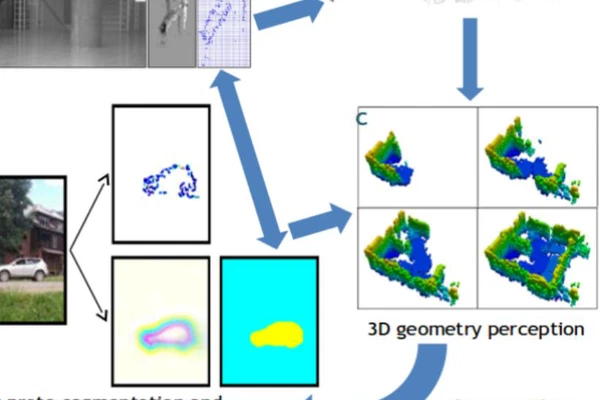
BIO-PERCEPTION - Next generation of smart vision systems for real-time processing with bio-inspired sensors

Our goal for this project is to set up the basis for a new generation of smart autonomous agents that are able to carry out 3D perception in real-time, using biologically-inspired vision sensors. These sensors independently processed all pixels and only trigger changes in the scene (events) in the case a substantial difference in the intensity luminance happens over time for a specific location (this happens only at object contours and textures). This allows for the reduction of the transmission of redundant information and hence, the data bandwidth.

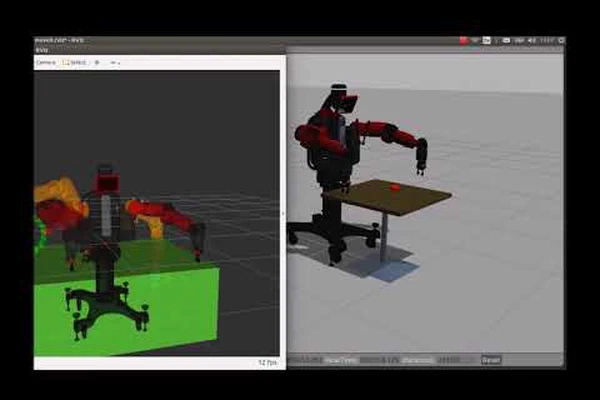
Object manipulation with the Baxter robot

Object manipulation with the Baxter robot

The project presents various demonstrations of pick and place tasks with the Baxter research robot, with object recognition and manipulation with objects of various shapes, sizes, and colours. It also includes trajectory and motion planning and the use of different grippers and simulation with Gazebo.

Latest News

We are hiring!

CVR-Lab is hiring for the BIO-PERCEPTION project